
If TVK MLAs and ministers are perceived as clean, or demonstrably cleaner than their predecessors, the credibility dividend will be enormous. The voter will feel rewarded, points out Ramesh Menon.

Indian equity benchmark indices Sensex and Nifty tumbled over 1 per cent for the third consecutive day, driven by a sharp rally in crude oil prices, massive selling in IT stocks, and unabated foreign fund outflows amid ongoing geopolitical tensions in the Middle East.
Indian benchmark indices Sensex and Nifty experienced a significant slump in early trade, driven by a sharp surge in crude oil prices above USD 120 per barrel, weak global market trends, and continued foreign fund outflows.

Indian equities on Dalal Street saw volatility as global market trends and weak rupee impacted investor sentiment. Track Sensex, Nifty50 movement and key market drivers for May 5, 2026.

Indian markets on Dalal Street rallied sharply as easing tensions in the US-Iran conflict and stable oil prices boosted sentiment. Track Nifty 50 and BSE Sensex performance and key global triggers.

Benchmark equity indices Sensex and Nifty extended their gains for the third straight session on Wednesday, driven by last-hour buying in bank, metal, and FMCG shares.

Indian benchmark indices, Sensex and Nifty, closed almost unchanged in a volatile session as investors reacted cautiously to mounting geopolitical headwinds and a significant jump in crude oil prices, with Brent crude surging to USD 94.68 per barrel.

'In the last one year, we have added more than Rs 1.7 trillion, and we are on track.'

Stock markets rebounded on Friday with the benchmark Sensex closing higher by 316 points after heavy buying in banking and metal shares amid optimism over trade deal progresses and India's participation in Pax Silica.

Indian benchmark stock indices, Sensex and Nifty, closed nearly 1 per cent lower following the collapse of US-Iran negotiations, which heightened concerns of a prolonged conflict in West Asia and drove crude oil prices sharply higher.

India emerged reasonably well from 2025. But now, the oil shock and war-related supply disruptions have again driven funds out of India and significantly weakened the rupee, points out Ajay Chhibber.

Mcap of top 6 most valued firms drops nearly Rs 65k cr; Airtel biggest laggard

Indian stock market indices Sensex and Nifty experienced a decline in early trade due to surging crude oil prices and ongoing geopolitical uncertainty in West Asia. Foreign fund outflows further contributed to the negative sentiment.
Indian stock markets tumbled sharply with the Sensex falling 800 points and nearly 4 lakh crore wiped out in a single session. Here are the 6 key factors, including rupee weakness and global cues, behind the crash.

Indian equities on Dalal Street saw volatility as global market trends and fresh tariff concerns linked to Donald Trump impacted investor sentiment. Track Sensex, Nifty50 movement and key market drivers for April 9, 2026.

The easing of external commercial borrowing (ECB) norms by the Reserve Bank of India (RBI) is expected to significantly boost overseas fundraising by Indian companies, market participants said.

Indian stock markets experienced a significant rally following the announcement of a US-Iran ceasefire, coupled with a drop in crude oil prices. The Sensex and Nifty both closed nearly 4 per cent higher, mirroring gains in global markets.

Though the banking and financial services sector has been ruling the campus so far, many students have opted to wear the entrepreneurial hat too.

Indian stock markets recovered from early losses to close higher, driven by value buying in IT and banking shares and a rebound in the rupee.

Even if there is an early agreement on a cessation of hostilities in West Asia, the price shock will not go away easily, points out A K Bhattacharya.
Indian equities on Dalal Street saw volatility as global market trends and fresh tariff concerns linked to Donald Trump impacted investor sentiment. Track Sensex, Nifty50 movement and key market drivers for March 30, 2026.

The Indian rupee depreciated by 32 paise to close at 92.83 against the US dollar, influenced by escalating global tensions, particularly the US-Iran conflict, and the deadline for the RBI's instructions to banks to curb overnight positions.
Indian markets on Dalal Street rallied sharply as easing tensions in the US-Iran conflict and stable oil prices boosted sentiment. Track Nifty 50 and BSE Sensex performance and key global triggers.

Cleaner balance sheets, regulatory support and strong growth prospects helped Indian private banks attract over $6 billion in foreign capital, with more deals expected in 2026.
Indian stock market benchmarks Sensex and Nifty rebounded by over 1% on Monday, driven by value-buying in banking stocks after a three-day slump. Key gainers included UltraTech Cement, HDFC Bank, and Mahindra & Mahindra.

The benchmark BSE Sensex's trailing 12-month price-to-earnings (P/E) multiple has declined to 20.2x, its lowest since May 2020, driven by a record $42 billion FPI selloff since September 2024 and concerns over corporate earnings and economic growth.

The Indian rupee depreciated by 52 paise to settle at 93.35 against the US dollar, driven by failed US-Iran peace talks, surging crude oil prices due to a potential US blockade of Iranian ports, and a global flight to the greenback. This geopolitical uncertainty is also leading to foreign capital withdrawal from domestic equities.

'At the first sign of real trouble, that money will move. There will be a run.'
Indian markets on Dalal Street rallied sharply as easing tensions in the US-Iran conflict and stable oil prices boosted sentiment. Track Nifty 50 and BSE Sensex performance and key global triggers.
Indian stock market indices Sensex and Nifty experienced a significant decline, driven by rising crude oil prices, sustained foreign fund outflows, and selling pressure in major bank stocks.

From the 30-Sensex firms, Tata Steel, Asian Paints, Trent, State Bank of India, Hindustan Unilever, UltraTech Cement, ICICI Bank and Bharti Airtel were among the gainers. On the other hand, Infosys, Bajaj Finance, Bharat Electronics, Larsen & Toubro and HDFC Bank were the laggards.
ICICI Bank, Eternal, Titan, Adani Ports, Tata Consultancy Services and UltraTech Cement were also among the laggards. However, InterGlobe Aviation, Tech Mahindra, Hindustan Unilever and Bajaj Finance were among the gainers.

The BJP-led government in Bihar secured a vote of confidence in the state assembly, with Chief Minister Samrat Choudhary pledging economic development and significant investments. The motion was passed amidst heated debates and accusations between the ruling NDA and the opposition, highlighting political tensions and differing views on issues like women's reservation.
Bharat Electronics, Reliance Industries, Mahindra & Mahindra, Larsen & Toubro, InterGlobe Aviation, ICICI Bank and UltraTech Cement were among the other major gainers. Axis Bank, Infosys, Tata Consultancy Services, Trent and Titan were the laggards.

Indian markets on Dalal Street rallied sharply as easing tensions in the US-Iran conflict and stable oil prices boosted sentiment. Track Nifty 50 and BSE Sensex performance and key global triggers.
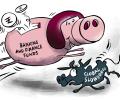
Even as banks and finance companies are reporting record-high earnings, their weighting in the benchmark National Stock Exchange Nifty50 Index has seen a downward trajectory. Investors expect a stronger performance from other sectors in the new year. Currently, banking, financial services and insurance (BFSI) companies collectively hold a weighting of 34.5 per cent, down from 36.7 per cent at the end of December 2022 and a record high of 40.6 per cent at the end of December 2019. This represents the sector's lowest weighting in the index since December 2021 when it stood at 33.7 per cent.
Benchmark equity indices Sensex and Nifty tumbled more than 1 per cent on Friday due to across-the-board selloff, especially in metal, IT and commodity stocks, tracking sluggish global markets.

Both sides have now revealed a preference for escalation over strategic defeat, and each new provocation narrows the space for the next pause. The Touska seizure, Iran's refusal to negotiate under blockade, Israel's strikes on Iranian oil infrastructure -- all of these add up to an increasingly untenable situation. This makes the wild card -- Trump and his motormouth -- more consequential than ever, notes Prem Panicker in his must read blog on the Iran War.

Indian equity investors experienced a significant loss of 16.32 lakh crore due to a two-day stock market decline fueled by escalating geopolitical tensions involving the US, Israel, and Iran.

'Credit growth in India remains in double digits, even though corporate borrowing is subdued.' 'Corporate credit is weak because companies are cash-rich and cautious amid global uncertainty.'
 © 2026 Rediff.com - Advertise with us - Disclaimer - Privacy Policy - Sitemap - Feedback - About us - Terms of use - Grievances